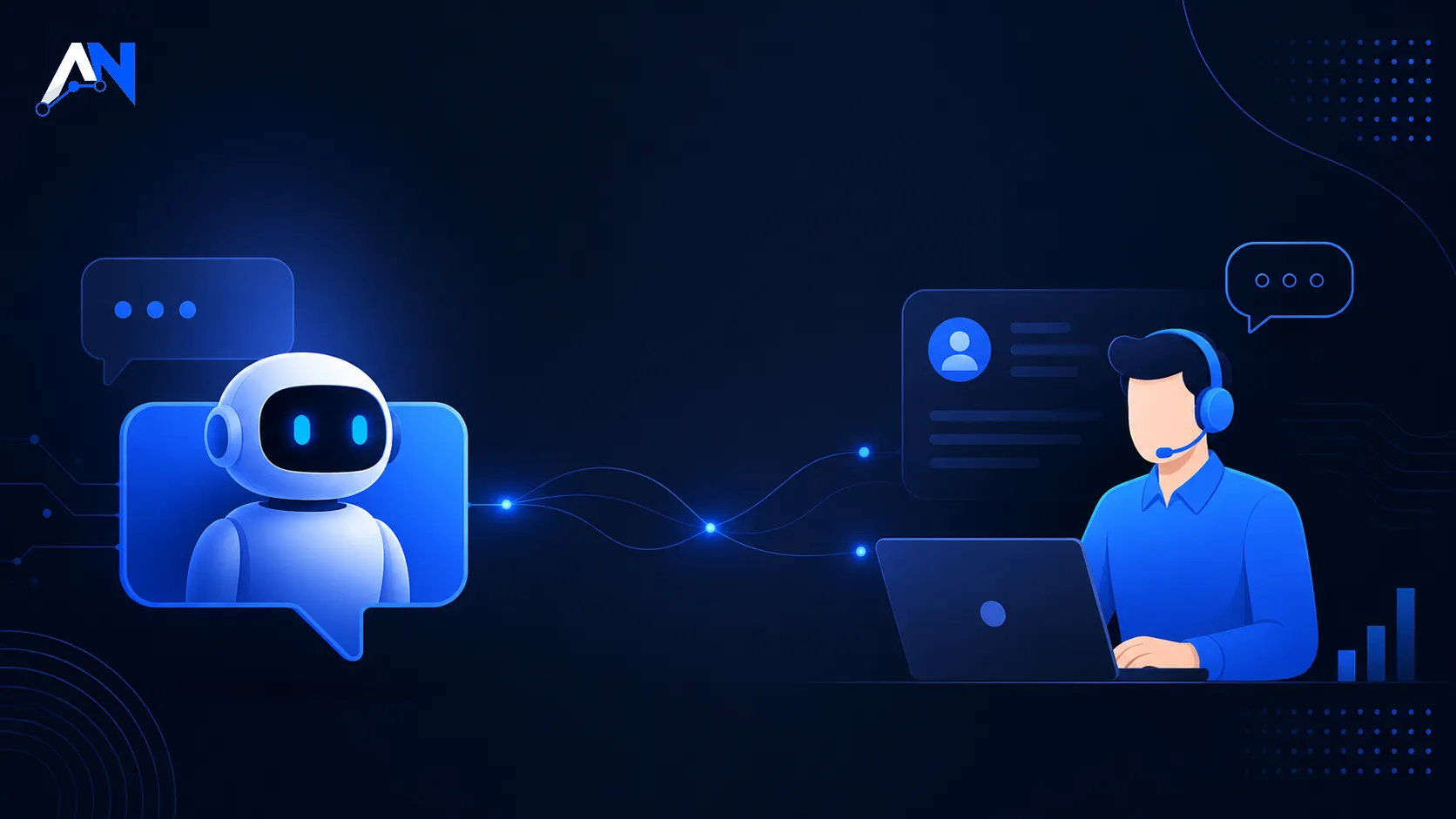
The growth of artificial intelligence has created an important question for businesses: should customer communication be handled by AI chatbots or human support representatives?
The most practical answer is not choosing one and completely removing the other.
AI chatbots and human employees have different strengths. Chatbots are fast, consistent, scalable, and available at any time. Humans provide empathy, judgment, creativity, negotiation, and deeper understanding.
The strongest customer service strategy combines both.
AI handles repetitive and predictable conversations, while human employees manage complex, sensitive, and high-value interactions.
What AI Chatbots Do Well
AI chatbots are particularly effective when customer requests follow common patterns.
They can answer questions about:
- Business hours
- Pricing
- Product availability
- Delivery policies
- Order status
- Appointment availability
- Service details
- Return procedures
- Basic troubleshooting
- Account information
These questions may be simple, but they often represent a large percentage of customer support volume.
Automating them allows customers to receive immediate answers and prevents employees from repeating the same information throughout the day.
Speed and Availability
Customers value quick responses.
A chatbot can reply within seconds, regardless of the time of day. It can support customers during evenings, weekends, holidays, and periods of high demand.
This is especially useful for businesses serving customers across different time zones.
Human teams require schedules, breaks, training, and workload management. A chatbot can support the team by handling incoming requests when employees are unavailable.
When a human response is required, the chatbot can still collect information and create a support request for later follow-up.
Scalability During Busy Periods
Customer message volume may increase during product launches, marketing campaigns, sales events, service interruptions, or seasonal periods.
A human team may struggle to manage a sudden increase in conversations.
AI chatbots can handle multiple interactions at the same time. They can provide consistent answers without creating long queues.
This scalability helps businesses maintain service quality during periods of high demand.
However, the chatbot should still identify urgent or important conversations and prioritize them for human attention.
Consistency
Human representatives may explain policies differently or occasionally forget important details.
A properly managed chatbot provides responses based on the company’s approved information.
This creates a more consistent customer experience.
For example, every customer can receive the same return requirements, warranty details, booking instructions, or service explanation.
Consistency is particularly valuable for businesses with multiple support representatives or locations.
The information provided to the chatbot must still be maintained. A chatbot using outdated policies will deliver incorrect information consistently, which can create serious problems.
Where Human Support Is Stronger
Chatbots are useful, but they cannot replace every form of human interaction.
Customers may contact a business because they are frustrated, confused, disappointed, or dealing with an unusual problem. These situations often require empathy and flexible decision-making.
A human representative can recognize emotional context, adjust communication style, negotiate a solution, and make exceptions when appropriate.
Humans are also better suited for complex sales conversations, strategic consultations, technical investigations, and sensitive complaints.
Emotional Intelligence and Empathy
When a customer has experienced a serious problem, an automatic response may feel impersonal.
For example, a customer whose important order was delayed may not simply want tracking information. They may need reassurance, accountability, and a practical solution.
A human employee can acknowledge the impact of the problem and respond with genuine understanding.
AI can help identify negative sentiment and notify a representative, but the final conversation may still require personal attention.
Complex Decision-Making
Some customer situations do not have a simple rule-based answer.
A refund request may depend on the customer’s history, the cause of the problem, the product condition, and the company’s relationship with the customer.
A business-to-business sales inquiry may require customized pricing, technical evaluation, and negotiation.
A chatbot can collect information and provide initial guidance, but an experienced employee should make the final decision.
Relationship Building
Customers often choose businesses based on trust.
Human relationships are particularly important in consulting, healthcare, real estate, financial services, software development, professional services, and high-value sales.
A chatbot can improve the beginning of the customer journey by responding quickly and organizing information. However, human interaction may be necessary to build confidence and maintain a long-term relationship.
Automation should create more time for meaningful conversations, not eliminate them.
Designing a Hybrid Support Model
A hybrid support model clearly defines which tasks should be automated and which should involve employees.
The chatbot may handle:
- Initial greetings
- Frequently asked questions
- Customer identification
- Lead qualification
- Order tracking
- Appointment booking
- Basic troubleshooting
- Document collection
- Support ticket creation
- Conversation summaries
Human representatives may handle:
- Complaints
- Negotiations
- Complex technical issues
- Custom quotations
- Sensitive personal matters
- High-value sales opportunities
- Policy exceptions
- Escalated support cases
The exact division depends on the business.
A small online store may automate order updates and product questions. A software company may automate lead qualification but involve a consultant during solution design.
Creating a Smooth Handover
The transition from chatbot to human support is one of the most important parts of the customer experience.
Customers should not feel trapped inside automation.
The chatbot should provide a visible option to request a person. It should also detect situations where human support is necessary.
Before transferring the conversation, the chatbot can collect the customer’s name, account or order number, problem description, and preferred outcome.
The employee should receive:
- Conversation history
- Customer information
- Relevant account details
- Actions already completed
- A short AI-generated summary
This allows the employee to continue the conversation without asking the customer to repeat everything.
Supporting Employees With AI
AI chatbots do not only communicate directly with customers. They can also assist human representatives.
During a conversation, AI can suggest replies, summarize previous interactions, retrieve relevant policies, recommend troubleshooting steps, and identify the next best action.
After the conversation, it can generate notes and update the CRM.
This type of employee assistance can reduce response time while allowing the human representative to remain responsible for the final answer.
It can also help new employees learn more quickly by providing relevant information during customer interactions.
Avoiding Over-Automation
Businesses sometimes attempt to automate too much.
This creates long menus, repetitive questions, irrelevant replies, and difficulty reaching a person.
Customers become frustrated when the chatbot continues repeating the same response even though it does not understand the problem.
Automation should be removed from any part of the journey where it creates more effort than value.
A useful chatbot recognizes its limitations. It should say when it cannot complete a request and provide the next appropriate step.
Protecting Customer Data
Both automated and human support systems must protect customer information.
Businesses should only collect data necessary for the conversation. Sensitive information should be handled through secure processes.
Employees should have appropriate access permissions, and chatbot integrations should use secure authentication.
Businesses must also communicate clearly about automated processing, customer consent, message preferences, and data usage.
Security and privacy should be part of the system design from the beginning.
Measuring the Hybrid Model
A business should evaluate both chatbot performance and human support performance.
Useful measurements include:
- First response time
- Resolution time
- Customer satisfaction
- Chatbot completion rate
- Human handover rate
- First-contact resolution
- Support volume
- Cost per conversation
- Repeat contact rate
- Sales conversion rate
These metrics should not be used only to reduce costs.
The main objective should be creating a better customer experience while improving operational efficiency.
Customer feedback can reveal whether the balance between automation and human support is working effectively.
For related guidance, explore AI chatbots and WhatsApp automation, AI chatbots for lead generation, WhatsApp automation implementation guide, and AI transformation in modern businesses. For hands-on implementation, review our AI services. Ready to discuss your goals? Contact AlphaNovix to plan the next step.
Conclusion
AI chatbots and human customer support should not be treated as competitors.
Chatbots are best for speed, availability, consistency, and repetitive tasks. Humans are best for empathy, judgment, complex decisions, and relationship building.
The ideal strategy combines both.
AI handles routine communication, prepares information, and completes simple actions. Human employees step in when the customer needs deeper understanding or personal attention.
This approach improves customer service while allowing employees to spend more time on valuable work.
Our agency helps businesses build hybrid customer communication systems that combine AI-powered WhatsApp automation with smooth human support, intelligent routing, CRM integration, and performance tracking.